


RevOps Improves Execution
Revenue Operations helps teams align processes, data, and reporting across marketing and sales.

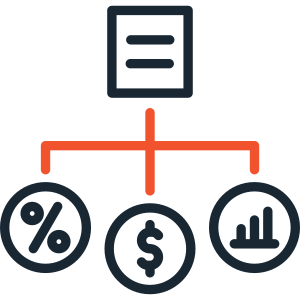
Revenue Architecture Designs The Full System
Revenue Architecture defines how all revenue systems should be structured, connected, and deployed.

RevOps Lives Inside The Architecture
RevOps is a critical operational layer, but it is not the complete model.
Architecture Creates Scalability
Without architecture, operational improvements often remain fragmented and tactical.
.png)
What Is Revenue Operations?
Revenue Operations focuses on operational alignment across the revenue process.
Its goal is to improve how marketing, sales, and CRM systems work together.
RevOps typically includes:
• Pipeline Management
• Lead Lifecycle Processes
• Revenue Reporting
• Sales And Marketing Alignment
• Forecasting And Operational Visibility
Revenue Operations is essential because it improves process consistency and helps organizations manage revenue execution more effectively.
The Core Difference
The simplest way to understand the difference is this:
Revenue Operations manages how revenue processes run.
Revenue Architecture designs how the entire revenue system is built.
.webp)
Revenue Operations As One Layer Of The Model
Revenue Architecture includes multiple operational layers.
Revenue Operations is one of them.
A complete Revenue Architecture often includes:
Demand Generation Layer
The systems that attract qualified buyers and generate demand.
Conversion Layer
The structures that convert visitors into qualified leads and opportunities.
CRM Infrastructure Layer
The systems that centralize customer data and pipeline activity.
Revenue Operations Layer
The operational processes that align teams and manage the pipeline.
Automation Layer
The workflows and intelligence systems that support efficiency and scalability.
This is why Revenue Architecture is a broader concept.
It includes RevOps, but it does not stop there.
When A Company Needs RevOps
A company usually needs RevOps when:
• Marketing And Sales Are Misaligned
• Pipeline Visibility Is Limited
• Forecasting Is Inconsistent
• Lead Management Is Fragmented
• Reporting Is Unreliable
RevOps helps create operational order.
It is often the right response when teams are already generating demand but struggling to manage it efficiently.
.png)

When A Company Needs Revenue Architecture
A company usually needs Revenue Architecture when:
• Demand Generation Is Not Producing Predictable Pipeline
• CRM Systems Are Understructured
• Revenue Processes Are Fragmented
• Automation Is Disconnected
• Leadership Needs A Scalable Revenue System
Revenue Architecture is the right approach when the business needs to design or redesign the full revenue engine.
It is especially valuable for B2B organizations with complex sales cycles, multiple stakeholders, and long buying journeys.
Why B2B Companies Need Both
For most B2B organizations, RevOps and Revenue Architecture should not be treated as competing ideas.
They should be understood as different levels of the same growth system.
Revenue Architecture defines the model.
Revenue Operations helps run the model.
Without architecture, RevOps can become tactical.
Without RevOps, architecture remains theoretical.
The strongest companies use both.
They design the system and then operationalize it.
-1.png)

How Ca Design Approaches Both
At Ca Design, Revenue Architecture is the broader framework we use to design growth systems.
Revenue Operations is one of the core operational layers inside that framework.
Our work helps companies:
• Analyze Their Current Revenue Systems
• Design Revenue Architecture Models
• Implement RevOps Processes
• Configure CRM Infrastructure
• Deploy Automation Systems
This allows organizations to move from fragmented execution to integrated revenue system design.

Designed for B2B organizations with complex sales cycles
The Revenue Architecture Framework is designed for companies operating in industries where growth depends on structured systems and long buying processes.
















.png)
Increase in qualified pipeline opportunities

Higher conversion rates across key funnel stages

Reduction in time-to-first-response from sales teams

We lead our clients to success.

Working with Ca Design transformed the way we attract and manage our customers. The HubSpot setup was seamless, and within weeks we had measurable improvements in reservations and follow-ups.

They guided us through a complete web and CRM relaunch. Beyond the technical setup, they gave us a clear roadmap to scale our digital presence. The difference in how prospects experience our brand is night and day.

Their team helped us connect our booking funnels with automation and remarketing. We saw more qualified leads from the U.S. and Europe, and our local SEO visibility went up significantly.


What impressed me most was the speed: in less than 30 days we had HubSpot, GA4, and our first campaigns running. The reporting makes it easy to see ROI week after week.
